


Apr 28, 2026, 11:00 AM
Identifying and Managing Black Cutworm
There are several species of cutworm that impact agricultural production across our Legend footprint. The name says it all, cutworms feed on plant vegetation, and in some cases (depending on the crop), they will actually cut the stalk or stem right at, or just below, the soil surface.
The most common, and most destructive, in our area is the black cutworm. These moths overwinter in Texas and Mexico, then migrate north from late February through early June. Black cutworm moths can “ride” high winds and low-level jet streams into the Midwest and Northern U.S.
These air currents can reach altitudes of up to 5,000 feet, allowing the moths to travel long distances in just 2 to 4 days (Iowa State University). Essentially, they get pulled into storm systems and carried north. Once conditions change, like temperature shifts or heavy rainfall, they will drop back down to the ground.
Once they arrive, they are drawn to low lying areas in fields, poorly drained soils (like ditches), spots with heavy weed pressure, or just areas with a lot of green vegetation, especially young corn.
After landing, the moths mate and lay eggs in this vegetation. When the larvae hatch, things can escalate quickly. A single larva can cut up to four corn plants during its life cycle. And considering a female moth can lay up to 1,000 eggs (SDSU Extension), populations can build fast.
While total field loss is rare, black cutworm damage in localized areas can range anywhere from 10% up to 80% depending on severity.
WHAT DO THEY LOOK LIKE…
MOTHS
Adult moths have a wingspan of about 1.5 to 2 inches and a few key traits that help set them apart (Iowa State University).
Key Features:
- Dagger mark: A distinct dagger shaped marking near the outer edge of the forewing
- Two toned wings: Dark purplish brown on the inner portion, with a lighter gray or clay colored outer third
- White hindwings: Pale white to light gray with darker veins and a slight brown tint along the edges
- Body type: Thick bodied and somewhat hairy
- Nocturnal: Moths are only active at night. You have probably seen them around yard lights or shop lights after dark without realizing it.
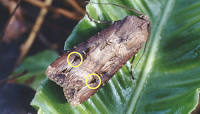 Photo Credit: University of Missouri
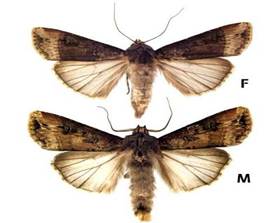 Photo Credit: Robert Bauernfeind, Kansas State University
LARVAE
Often called “greasy cutworms” because of their shiny, almost oily appearance, these larvae are thick bodied caterpillars that can grow up to 2 inches long. Their skin has a slightly rough, grainy texture (Iowa State University).
Key features:
- Color: Light gray to nearly black, sometimes with a faint stripe down the back
- Head: Shiny, dark brown or black
- The “C” shape: When disturbed, they curl tightly into a C or spiral
- Tubercles (small bumps): Pairs of bumps along each segment. The front bump is about one third the size of the rear one, which helps tell them apart from similar species.
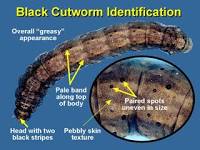 Photo Credit: University of Nebraska-Lincoln
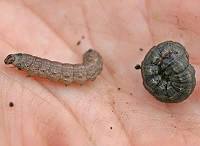 Photo Credit: Roger Schmidt, University of Wisconsin-Madison, Bugwood.org
IDENTIFYING DAMAGE
EARLY STAGES
When larvae are small (1st to 3rd instar, under 1/2 inch), they feed mostly on leaves (University of Wisconsin).
Key indications:
- Pinholes: Small, round holes in leaf tissue
- Window paning: Feeding that leaves a thin, transparent layer on the leaf
Significance: Not usually yield threatening, but definitely a warning sign that bigger larvae are coming (Purdue University)
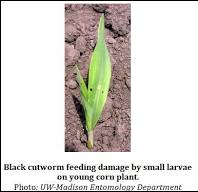
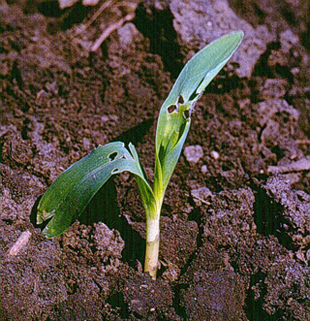 Photo Credit: University of Nebraska-Lincoln
MIDDLE STAGES
At the 4th instar (about 1/2 to 3/4 inch long), larvae start cutting plants.
Key indications:
- Stem notching: Chewing into the stalk at or just below soil level
- Complete cutting: Severing plants at the base, causing them to fall over
- Dragging: Cut plants may be pulled slightly underground or under clods where larvae continue feeding.
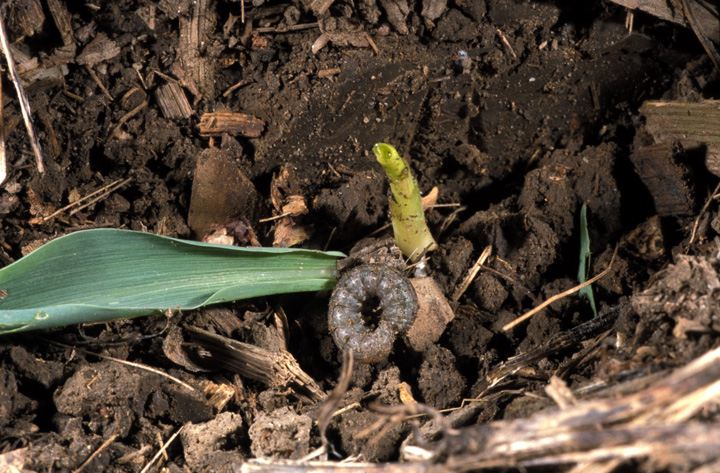 Photo Credit: John Obermeyer, Purdue University
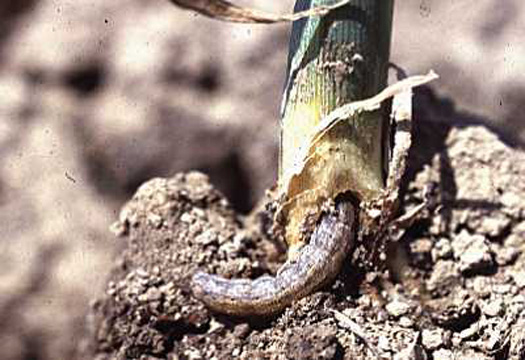 Photo Credit: Ohio State University Extension
WHEN DAMAGE IS MOST SEVERE…
Most damage occurs from crop emergence through the V5 stage. After V5, plants are usually large enough that cutworms struggle to cut through the stalk. Damage can still happen, but the risk drops off quite a bit.
MANAGEMENT
There are several steps you can take to manage cutworm pressure:
- Seed treatments: Provide early season protection, though may not be enough in heavy infestations.
- Scouting: Start as soon as the crop emerges, early detection is key.
- Thresholds: Typically, if 2 to 3% of plants are cut in affected areas, action should be considered to prevent further loss.
- Insecticides: If it is determined that the population of cutworm is at a severe level, foliar applications of insecticides can be used to kill the cutworms.
- Tillage: To keep numbers down for upcoming seasons, using conventional tillage to get rid of debris and weeds will reduce the sources cutworm need to survive.
SUMMARY
In agriculture, the first step is always knowing whether you actually have a problem. Understanding what to look for, and when and where to look, can make all the difference.
Staying ahead of black cutworm pressure gives you a much better shot at keeping them from becoming a real issue later in the season.
REFERENCES
-
Missouri Pest Monitoring Network, Black Cutworm I.D., https://ipm.missouri.edu/pestMonitoring/bcw/identification.cfm
-
Black Cutworm on Corn, https://ohioline.osu.edu/factsheet/ENT-35
-
Corn Cutworms, https://extensionpubs.unl.edu/publication/g1153/2013/html/view
-
Managing Black Cutworm in Wisconsin Corn Fields, https://cropsandsoils.extension.wisc.edu/articles/managing-black-cutworm-in-wisconsin-corn-fields/
-
Critical Time For Black Cutworm Scouting, https://extension.entm.purdue.edu/newsletters/pestandcrop/article/critical-time-for-black-cutworm-scouting/
-
Black Cutworm Damage Potential for Corn, https://ipcm.wisc.edu/blog/2011/05/black-cutworm-damage-potential-for-corn/